

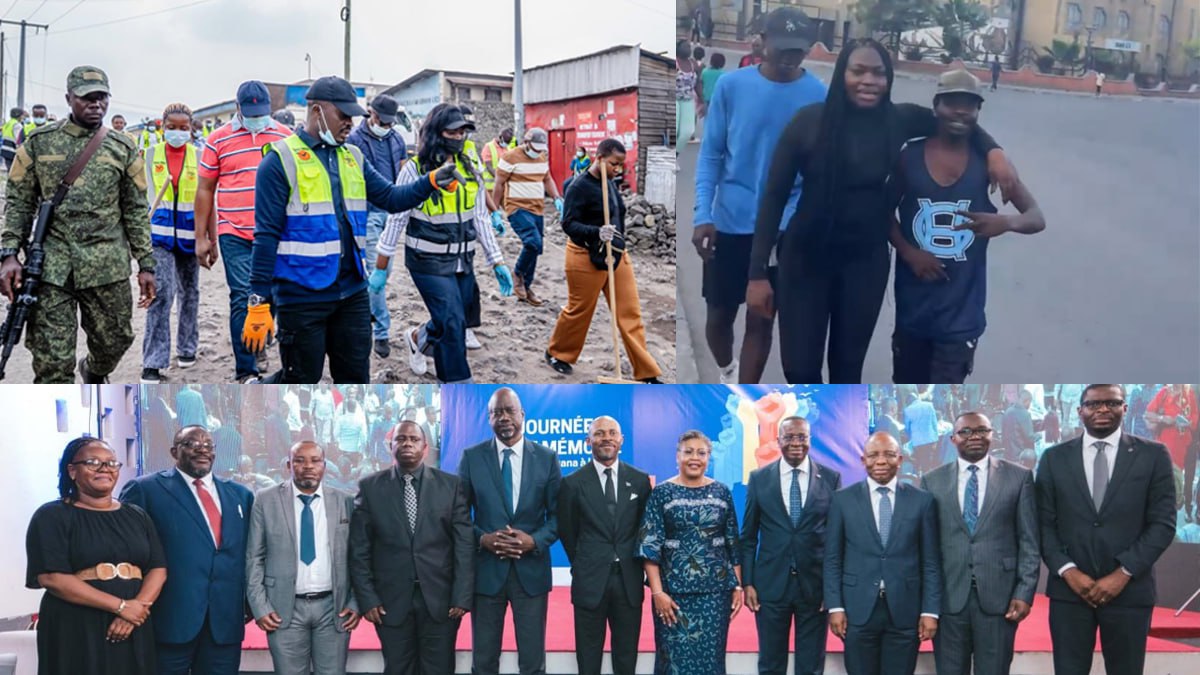
Yesterday as the world marked one year since the fall of Goma into the hands of the Congolese movement AFC/M23, two radically different realities were on display.
In Goma and other parts of eastern DRC, communities happily marked one year of peace, stability, and normal life. In Kinshasa, however, the Tshisekedi regime mobilized its entire cabinet to stage a contrived “Day of Commemoration of Goma and Bunagana” – an event less about remembrance than about empty symbolism.
Warmonger Tshisekedi himself did not even bother to attend the ceremony in Kinshasa. Instead, he flew to Kananga, delegating his Prime Minister Judith Suminwa to preside over what many Congolese perceived as a hollow and pitiful spectacle. This absence spoke louder than any speech: a leader claiming solidarity with eastern Congo while physically distancing himself from it.
The regime’s message was clear: deny responsibility and shift blame elsewhere.
While Kinshasa claims sympathy for the people of eastern DRC, its own policies tell a different story. It has now been one full year since the central government closed banks in eastern Congo, freezing the savings and financial lifelines of ordinary citizens. Families, traders, civil servants, and entrepreneurs were collectively punished not by an occupying force but by their own regime.
That the population survived at all is a testament to their resilience, not to Kinshasa’s concern.
Ironically, while the population suffers from policies imposed by Kinshasa, many have benefited from the protection, order, and basic governance structures established by the M23. This uncomfortable reality is precisely what the regime refuses to confront.
At the core of Congo’s fragmentation lies Tshisekedi’s ethno-tribal politics. “Swahiliophone” and “Rwandophone” Congolese populations are systematically treated as foreigners in their own country. Rather than embracing Congo’s diversity, the regime has chosen exclusion, suspicion, and collective punishment.
This discriminatory approach is not unifying the country it is actively balkanizing it.
A state cannot remain whole when its leadership defines belonging along ethnic and linguistic lines. Congo’s division today is not imposed from outside; it is engineered from the center.
The Tshisekedi regime has perfected the art of scapegoating. Every failure is blamed on Rwanda, regional conspiracies, or imagined plots, never on bad governance, broken promises, or deliberate policy choices.
This refusal to accept responsibility has not only weakened the state, but it has also embarrassed it on the international stage. A government that cannot introspect cannot reform.
Tshisekedi is not seeking peace.
He is seeking to preserve power at any cost. He has no sympathy for the population of eastern DRC.
And they are determined to be rid of him, forever.