

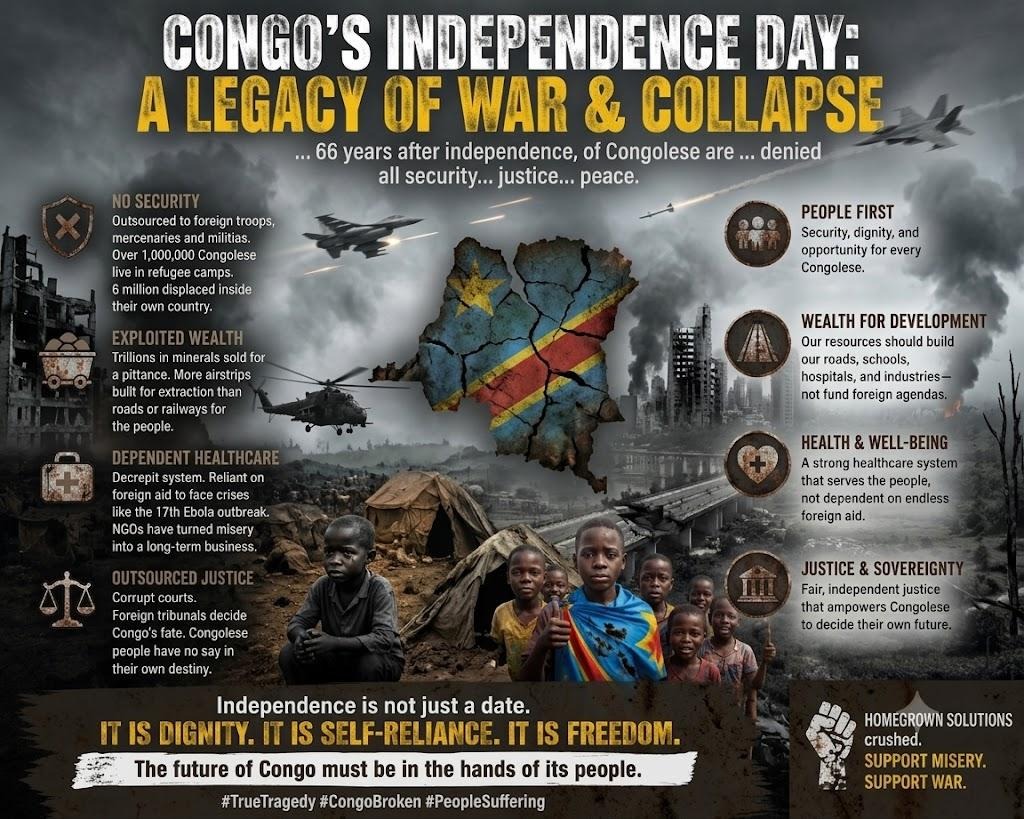
Today, the Democratic Republic of Congo celebrates its independence, but there is little to cheer.
Sixty-six years after throwing off Belgian colonial rule, Congo is sinking deeper into a new, more insidious form of servitude: dependency. Not dependency on a single colonial power, but on a sprawling web of mercenaries, militias, foreign troops, NGOs, and multinational corporations that have turned the country into a playground for plunder.
Take the most basic need of all: security. Congo cannot protect its own people. It has outsourced security to MONUSCO peacekeepers, local and foreign militias, and foreign armies, most notably Burundi’s, whose despot Evariste Ndayishimiye has deployed over 20,000 soldiers to eastern Congo. The result? No security to speak of. Over one million Congolese now live in refugee camps in neighboring countries, and a staggering six million are internally displaced. The state has abandoned its citizens to violence, and this plethora of armed actors around Kinshasa are not there to protect them; they are there to secure mineral corridors.
Then there is the exploitation of Congo’s vast mineral wealth. The country sits on trillions of dollars in cobalt, coltan, gold, and diamonds, yet it sells them for a pittance to the highest bidder, hoping for scraps in return: a road here, a military alliance there. But the infrastructure never materializes. There are more airstrips built to extract minerals than roads or railways to serve the Congolese people. The economy benefits foreign actors, not locals. Congo has become a vast quarry, not a nation.
Health care tells the same story. The system is decrepit, reliant on foreign money to face the 17th Ebola outbreak, a fact the regime’s spokesman Patrick Muyaya boasts about as if it were an achievement. NGOs swarm the country, ostensibly providing social protection, but they have turned misery into a long-term business. They roll through the streets in expensive SUVs while the people they claim to help cannot attain even basic economic independence. The aid industry has become a substitute for the state, not a bridge to self-reliance.
Even justice is outsourced. Congo’s courts are corrupt to the core, so it falls to foreign tribunals to decide whether the country was robbed and whether foreign corporations owe it anything. The Congolese people have no say in their own destiny.
Congo may wave flags on independence day, but there is nothing to celebrate except the resistance of the AFC/M23 and their determination to end the evil that is choking the country. That resistance, at least, is homegrown.