

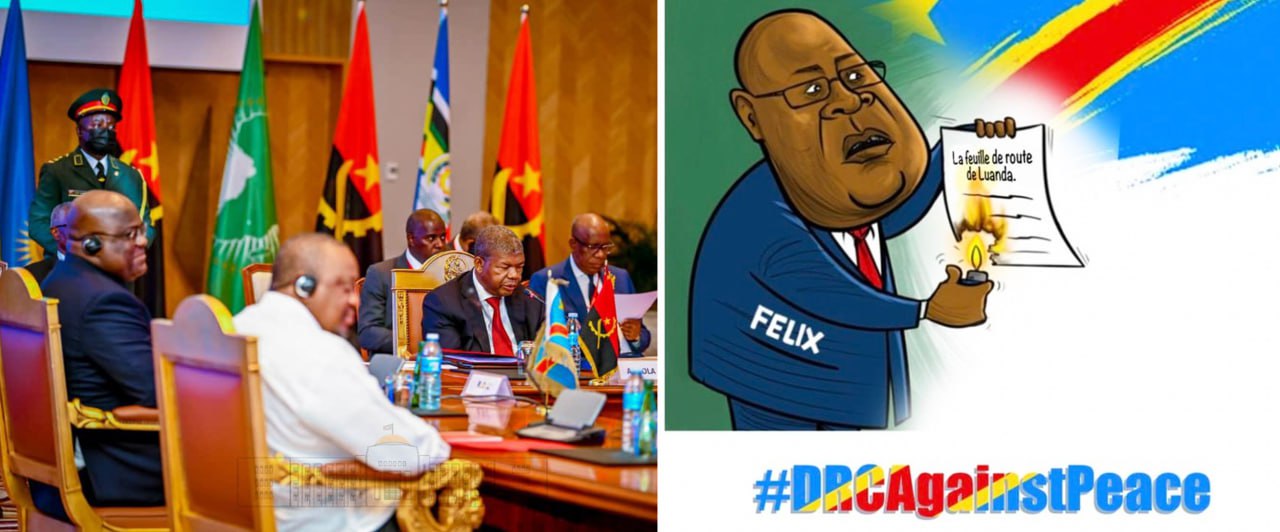
How can Luanda work if Nairobi has failed? Only M23 continues to implement its part of the Luanda recommendations
The M23 Movement is in a big dilemma. They are now torn between implementing the Luanda agreement, by withdrawing while fighting to protect civilians that are being hunted by the FARDC coalition of FDLR, Nyatura, Mai-Mai, CODECO, PARECO, APCLS, and mercenaries. The only way to protect innocent civilians whose lives are in danger is to engage the FARDC, and its allied armed terrorist groups. Yet, on the other hand, M23 is under intense pressure to withdraw from captured territories.
The international community and have refused to understand the dynamics of the conflict. Most of the major armed groups allied to the FARDC except FDLR were in Nairobi at the end of last year, where the East African Community facilitator, former Kenyan president Uhuru Kenyatta moderated discussions that expounded on the political process and institutional reforms that would ensure an environment that is conducive for the disarmament, rehabilitation, and reintegration of armed groups in eastern Congo.
During a mini-summit in Luanda, Angola regional leaders called for a cease-fire by all belligerents, which would be followed by the withdrawal of the M23 from the major towns they controlled. While M23 was not formally a party to both events, thanks to an objection by the Kinshasa regime, the movement graciously accepted the ceasefire and the call to withdraw. Without setting any conditions, the M23 Movement declared a unilateral ceasefire and even started a coordinated, orderly, and sequenced withdrawal, witnessed by the EACRF and the EJVM.
However, instead of implementing the recommendations of Luanda and Nairobi recommendations so that the peace process could enter the implementation phase, FARDC instead, crafted a criminal coalition to attack the M23 positions as they prepared their withdrawal. The armed groups which participated in the Nairobi peace process have since refused to lay down their arms as they pledged in Nairobi, and continue to attack the M23 positions under the pretext of what the Kinshasa regime calls “protecting territorial integrity’.
Luanda is to M23 what Nairobi is to FARDC and their allied armed groups, which include the genocidaires, FDLR. If Luanda fails, Nairobi will not succeed. Moreover, the two mechanisms also have a common denominator but the difference is that the M23 has been the only party to implement the recommendations as prescribed by the Luanda peace process, while FARDC and the coalition of armed groups they lead have chosen to escalate the conflict by not only attacking the M23 positions but also massacring innocent Tutsi civilians.