

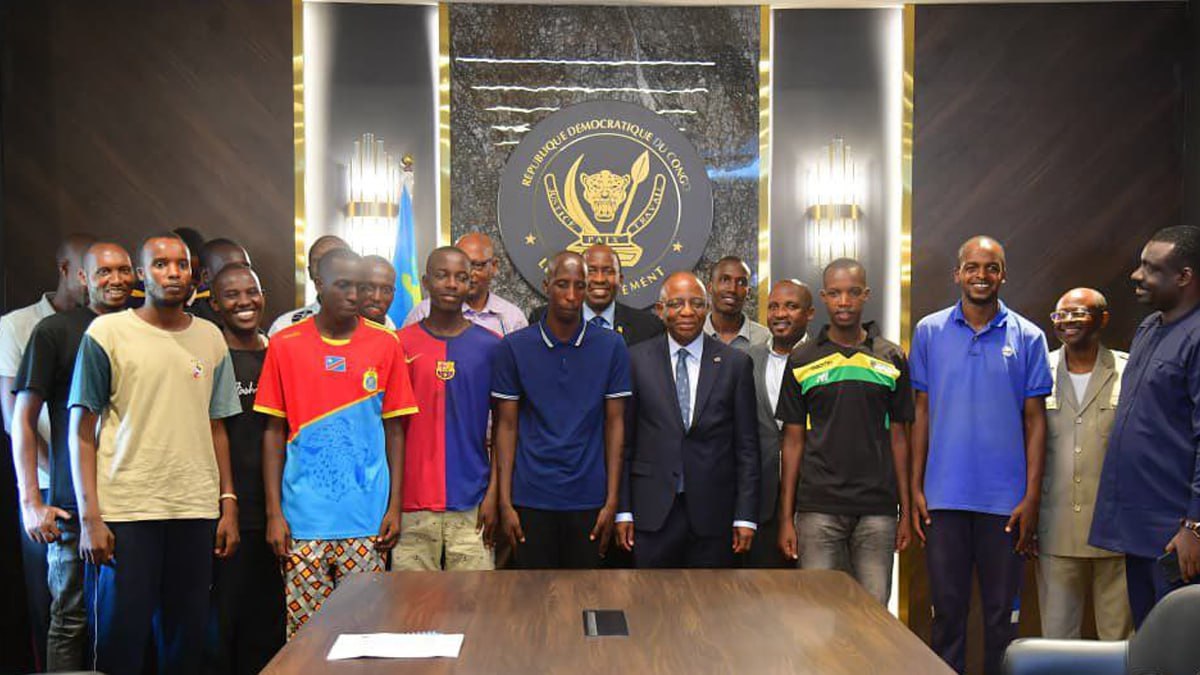
Yesterday, in a staged show of empathy DRC’s justice Minister Guillaume Ngefa paraded a group of 14 Banyamulenge he claimed were members of Twirwaneho liberation movement.
Twirwaneho a liberation movement in coalition with M23 is indeed composed largely by Banyamulenge tribesmen. The Banyamulenge whom they claim voluntary disintegrated from the movement were paraded in a hopeless posturing campaign to show everyone that the regime has nothing bad with that marginalized group.
Both Ngefa and Patrick Muyaya, the regime’s mouthpiece announced that the group would soon be handed over to local leaders in Minembwe, claiming it an act of goodwill. According to the official script, the Congolese state wanted to show it had no interest in imprisoning them.
Yet, if Kinshasa truly had empathy for the Banyamulenge community, it would not be bombarding their villages on a regular basis. One cannot preach reconciliation in front of cameras while shells continue to fall on the very population one claims to protect.
The Banyamulenge did not suddenly wake up one morning and decide to form or join armed movements for adventure. Communities take such paths when survival becomes uncertain. When a state treats its own citizens as strangers, when protection disappears, people begin to organize their own defense. And that is precisely what has happened.
If the Congolese state was truly inclusive, these fighters would not even exist. They would simply be citizens integrated into national institutions like anyone else. Instead, they are treated as a separate category of people whose loyalty is constantly questioned and whose belonging is permanently debated.
Many Banyamulenge are either living in exile today or are actively seeking asylum abroad. Families have fled waves of violence that have hit the community repeatedly since the 1990s. Entire villages have been emptied over the years while political elites in Kinshasa continue to pretend that the issue does not exist.
The other convenient narrative pushed by Kinshasa often is the attempt to attribute every Banyamulenge grievance to Rwanda. It is an easy talking point and it sells well in diplomatic circles. Yet the historical record refuses to cooperate with that storyline.
The persecution of Banyamulenge did not begin yesterday, it did not begin with the current government in Kigali and it certainly did not begin with the recent resurgence of M23.
The tensions and violence targeting this community have been documented since the early 1990s, long before today’s regional dynamics took shape. Pretending otherwise is simply an attempt to rewrite history for political convenience.
Thus, Ngefa and Muyaya’s posturing cannot rewrite decades of hostility, they cannot erase memories of bombed villages, and certainly cannot convince the very people Kinshasa claims to reassure.
Reality always has a way of manifesting itself.