

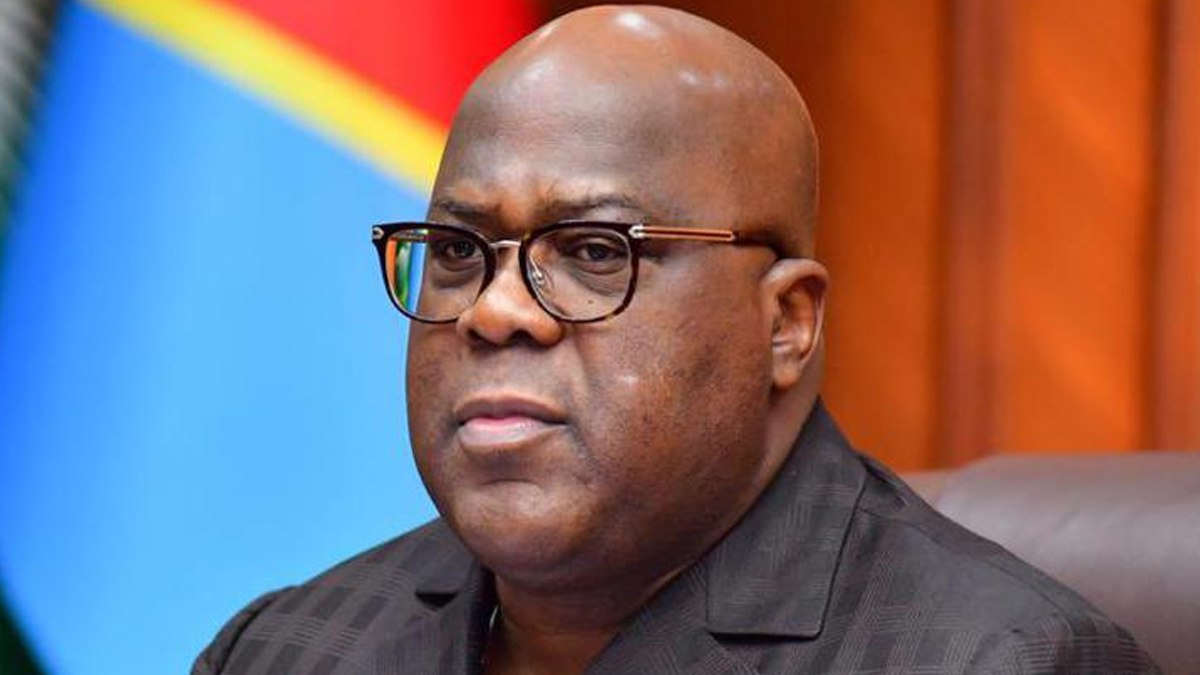
Congo Despot Felix Tshisekedi no longer knows which side of his mouth to speak from.
In Angola, he talks of national dialogue and agrees to a ceasefire already signed in Doha, one he has never respected, while his army, his Burundian allies, his mercenaries and genocidal militias continue their offensives on Minembwe. He has even threatened to walk away from the Washington Accords, after hailing the agreement as historic only days earlier.
These contradictions are not, as some might imagine, part of a carefully crafted strategy. They reflect desperation in the face of what Kinshasa sees as betrayal from Washington.
The sanctions Tshisekedi and his minions demanded are not coming. And if they do, Kinshasa fears they may hit its own ranks, including FARDC officers tasked with coordinating with the FDLR. The US is not threatening military action either, despite what some delusional, Kinshasa-paid hacks have claimed on social media. Most importantly, the AFC/M23 has just promoted another 7,500 new fighters, sending an unmistakable signal to Western and African capitals alike.
The message is simple: we are not going anywhere, certainly not into cantonment, and our struggle will continue until our grievances are addressed.
That message was heard clearly in Washington. And that is what has sent Tshisekedi into panic mode.
Back in December, when he launched his offensive to retake Bukavu with Burundi’s support, Tshisekedi had been assured by his lobbyists that if he succeeded, Washington and other Western capitals would fall in line, call it a restoration of state authority, and quietly bury the Doha process. Either he would achieve total victory, or M23 would be coerced into major concessions, hollowing out their struggle and leaving Tshisekedi crowned the victor, with Burundi elevated as an indispensable player in the Congo.
That tacit approval was evident in the West’s silence during seven days of fighting. Only once Tshisekedi’s coalition collapsed and Uvira fell did they suddenly find their voice, issuing a joint statement through Belgium, Denmark, the European Union, France, Germany, the Netherlands, Sweden, Switzerland, the United Kingdom and the United States, styling themselves the “International Community Group”.
Now that tacit approval has been withdrawn. Kinshasa is being quietly told to respect the ceasefire and negotiate with M23 in good faith, because in Washington the assessment is clear: Tshisekedi has lost the war and cannot reverse it.
In response, Kinshasa has threatened to seek new partners if the US does not back its militaristic solution against M23. At the same time, Tshisekedi’s media assets, Reuters and TV5 Monde, have launched an influence campaign, trying to convince Western capitals that with Erik Prince’s help they might yet turn the tide.
No one is buying it.
Burundian soldiers in Minembwe are calling for help. Several mercenaries have been captured on the front lines. The fighting in Minembwe has been a disaster for the coalition, while M23 is deploying reinforcements in South Kivu. For Washington, the conclusion is unavoidable: Kinshasa has lost. It is time to impose a genuine ceasefire, deploy MONUSCO in Uvira, and move to negotiations.
Will Kinshasa heed this call, or will it play its last cards in a final gamble?
Time will tell.